
Global drone news · July 2026
Six stories worth looking up for
If June was the month the future felt close, July was the month it landed. A British electric aircraft transitioned from helicopter to aeroplane in front of a live Farnborough crowd. An electric aircraft carried a donor organ across state lines. A cargo drone climbed higher than the summit of Everest. And in a lab, a 300-gram robot learned to dive into water and burst back out again like a seabird. As a CAA-registered operator surveying roofs across North London, here’s what caught our eye this month. Every story has been checked against at least two independent sources.
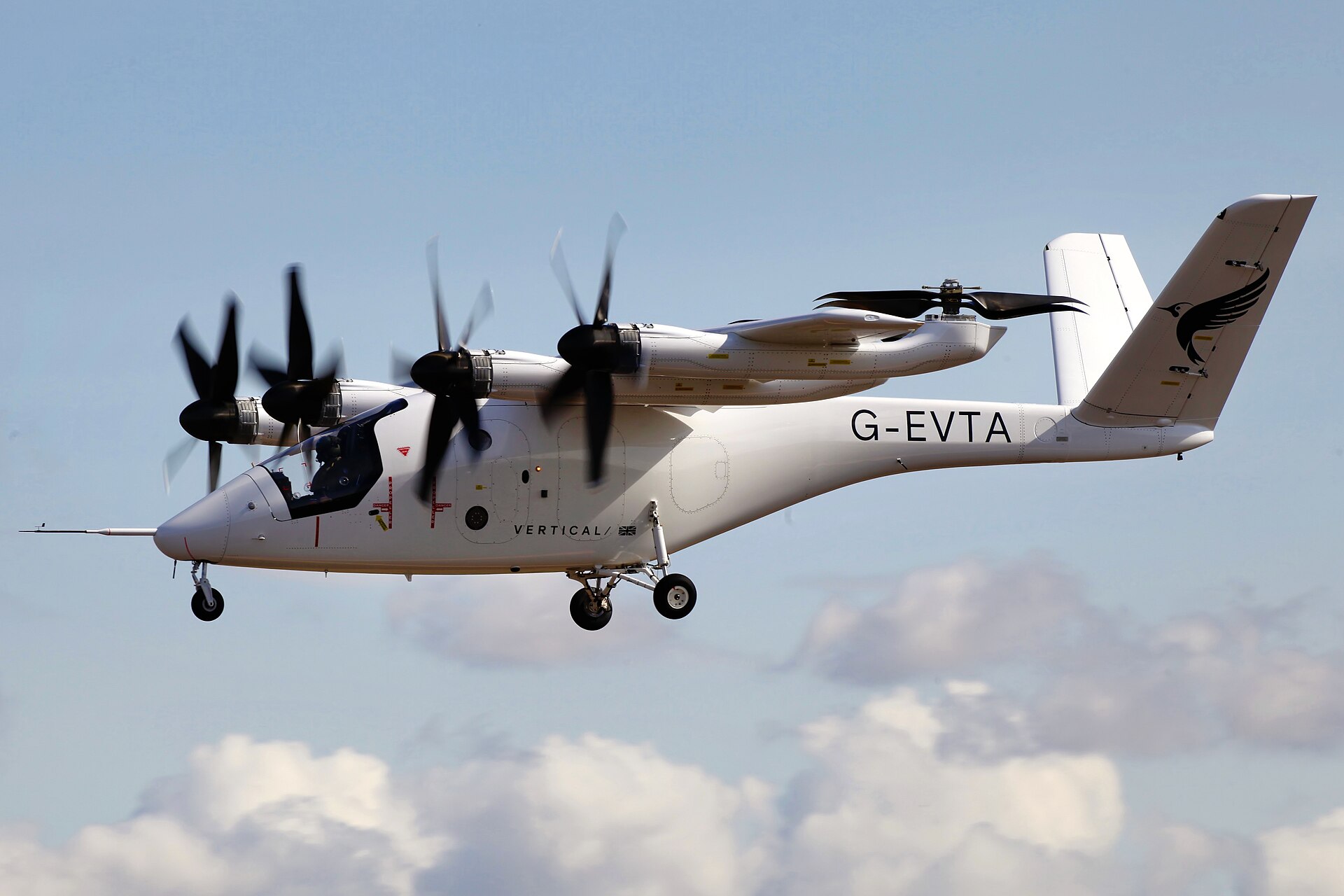
Header image: Vertical Aerospace VX4 (G-EVTA) in flight, by Colin Cooke Photo, licensed CC BY-SA 4.0, via Wikimedia Commons.
A British air taxi just made history at Farnborough
We flagged this one in June, and it delivered. On 20 July at 1:46pm, in front of aerospace leaders, regulators and the world’s press, Bristol-based Vertical Aerospace flew its full-scale VX4 prototype at the Farnborough International Airshow — lifting off vertically like a helicopter, transitioning into winged cruise flight, then transitioning back for a vertical landing. Chief Test Pilot Simon Davies was at the controls.
It was the first public eVTOL transition flight ever performed at an airshow. Farnborough has hosted a lot of aviation firsts — Samuel Cody’s pioneering powered flight in Britain in 1908, the Airbus A380’s public debut in 2006 — and electric aviation has now joined that list. The company had performed the manoeuvre privately in April; doing it in a live flying display, on schedule, in front of an audience is a very different order of confidence.
Verified via: Vertical Aerospace, HeliHub, AIN Online, Business Wire.
An electric aircraft carried a donor organ across state lines
In mid-July the FAA announced that BETA Technologies and United Therapeutics had completed an interstate flight test transporting a donor organ by electric aircraft — part of the FAA’s eVTOL Integration Pilot Program. One of BETA’s ALIA aircraft flew an organ in a medical transport cooler from Virginia Tech Montgomery Executive Airport to Charlottesville; ground crews then transferred the container to a second ALIA, which continued via Frederick, Maryland to Martin State Airport near Baltimore.
This was a reliability test rather than a clinical transplant — the organ was an animal organ — but the point stands. Organ transport is one of the few logistics problems where minutes genuinely decide outcomes, and a quiet electric aircraft that can land almost anywhere is a serious answer to it. It’s also a neat illustration of how quickly “experimental” aircraft find real jobs.
Verified via: FAA newsroom, DroneLife, Commercial UAV News.
DJI’s first cargo eVTOL flew higher than the summit of Everest
DJI used July to unveil the EV50, its first eVTOL delivery aircraft and a clean break from every multirotor it has sold before. It pairs eight vertical-lift rotors with three pusher propellers behind a 7-metre wingspan, carries a 50kg payload in a 270-litre bay, and has a range of roughly 150km. The lift rotors lock into an aerodynamic position during cruise to cut drag, and an emergency parachute is standard.
Working with Peking University, the EV50 carried ozone-measuring equipment on twelve flights over twelve days above the Himalayas, reaching a peak altitude of 29,072 feet — slightly higher than Everest’s 29,032ft summit — with a single continuous climb of 12,238 feet. Camera drones have crossed the summit before; hauling scientific instruments up there is a considerably harder problem. As ever, the engineering that survives thin, freezing air eventually shows up in the survey drones we fly, including our sub-250g DJI Mini 5 Pro.
Verified via: DJI press release, DroneXL, Notebookcheck.
The 300-gram robot that swims underwater and leaps back into the sky
Our favourite story of the month. A team from MIT and Switzerland’s EPFL published work in the journal Science on FAAV — a 300-gram puffin-inspired robot that flies through air, dives into water, swims, and then bursts back out into flight in under a second.
The engineering problem is genuinely brutal: water is over 1,000 times denser than air, so a wing that works in one is hopeless in the other. The team’s answer was wings that fold and bend underwater to shed drag while still generating thrust, a short flexible steerable tail for balance, and a near neutrally-buoyant body. Researchers see it collecting water samples and monitoring lakes, coastlines, wetlands and marine wildlife without disturbing anything — the sort of survey work that currently needs a boat, a team and a very patient afternoon.
Verified via: Journal Science, MIT Mechanical Engineering, Moneycontrol.
The paperwork bottleneck holding back UK drone flying just got automated
Less glamorous than an air taxi, arguably more consequential. On 20 July, Exeter-based Dronedesk — a fleet management platform used by more than 840 organisations — launched what it believes is the first fully automated Specific Operations Risk Assessment (SORA), covering both the UK SORA framework and EASA’s JARUS SORA 2.5 methodology.
SORA is the gateway to the Specific category and to Beyond Visual Line of Sight flying, which underpins nearly all commercial drone growth — inspection, survey, mapping, delivery. The bottleneck has rarely been the aircraft; it’s been the approval, and specifically the population density assessment beneath a proposed route, which could swallow hours of specialist GIS work. That now runs in seconds inside the flight planner. Combined with the CAA’s Future of Flight roadmap targeting routine BVLOS by 2027, the path from “we could fly that” to “we’re authorised to fly that” is getting dramatically shorter.
Verified via: GlobeNewswire, Markets Insider; UK CAA.
Drone shows quietly took over the Fourth of July
America’s 250th anniversary weekend was the tipping point. Across the US, hundreds of towns and cities ran synchronised drone light shows — some paired with fireworks for a bigger finale, many replacing them entirely. Boston’s show drew national coverage; Texas, Michigan, Idaho, New England and Wisconsin all staged large displays, with a single operator, Sky Elements, running performances from New York to California across the weekend.
The appeal is obvious: no smoke, no fire risk in a dry summer, far less noise for pets and wildlife, and imagery that can be redesigned in software rather than rebuilt in gunpowder. Last month’s world-first drone scoreboard above the Seattle skyline — updating live with World Cup match results — hinted at where this goes next. Fireworks have had a very good four centuries; they now have a credible rival.
Verified via: DroneDJ, CNN, USA Today, DroneLife.